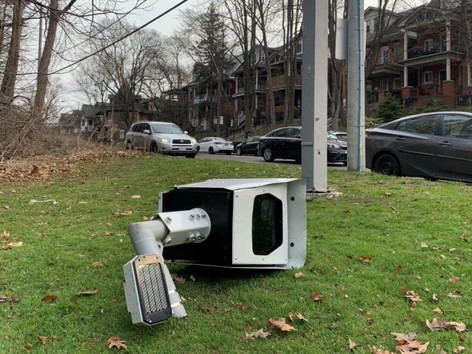
This six-time vandalized automated traffic speed camera on Parkside Drive has issued 66,000 tickets and generated more than $7 million in fines.
This may be good news for some motorists in a hurry.
City officials are trying to limit tickets issued by its 150 Automated Speed Enforcement (ASE) cameras to one per camera following complaints the devices are being used as a cash grab.
Council will consider at its July 23 – 25 meeting a plan to limit the number of tickets issued by the cameras to one from a single location if the motorist has no previous infractions.
The proposal by the City Solicitor, and Transportation Services, has to be approved by Council.
The purpose of this report is to “assess the feasibility of limiting the number of ASE infractions an individual vehicle owner can receive from a single camera location prior to receiving their first ASE infraction in the mail.”

The camera was cut down even though a second camera was installed to monitor the traffic cam.
“The enforcement of regulatory offences, including those for red light cameras and ASE, are not designed to be revenue generation tools for municipalities,” according to the report. “The fines and penalties associated with these offences are for the purpose of deterring behaviour determined to be a risk to public safety.”
The proposed change stems from outcry following the early July vandalism for the sixth time of the City’s most productive machine on Parkside Drive, despite having its own security camera. That ASE has issued more than 66,000 tickets and generated more than $7 million in fines since being installed in 2022.
City staff said if the proposal is approved it can result in a potential reduction of almost 6,000 infractions, or some $520,000 in lost revenue. It is estimated to cost about $30,000 to make changes to the devices.
The Toronto ASE program was launched in 2020 with 50 cameras which has increased to 150 today. Some 126 are mobile and 24 are in permanent locations.
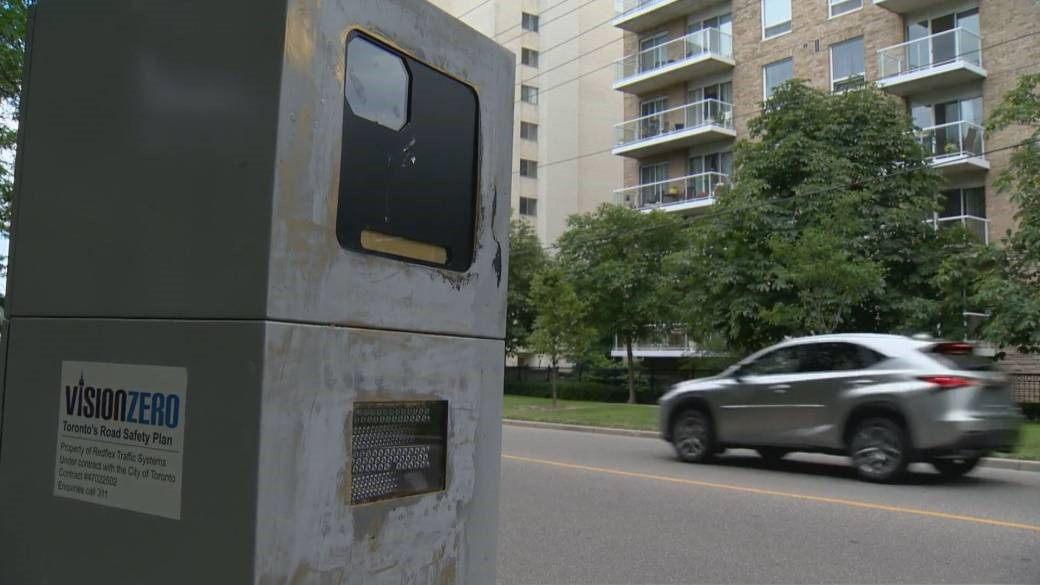
Almost 95,000 tickets were issued in the first month in which all the City’s 125 cameras were operational. They generate about $34 million yearly.
The first month of enforcement of the 150 cameras resulted in 94,250 tickets being issued to unsuspecting motorists, the report said.
“Higher speeds contribute to a higher risk of serious injuries and fatalities,” the report stated. “When collisions occur at higher speeds, the impact force has a high likelihood of causing a serious injury and fatality.”
ASE cameras are permitted in school zones and community safety zones, with a large volume of pedestrian activity, particularly children and older adults, who are the most vulnerable road users.
More than $34 million yearly are generated by the ASEs for the City.