
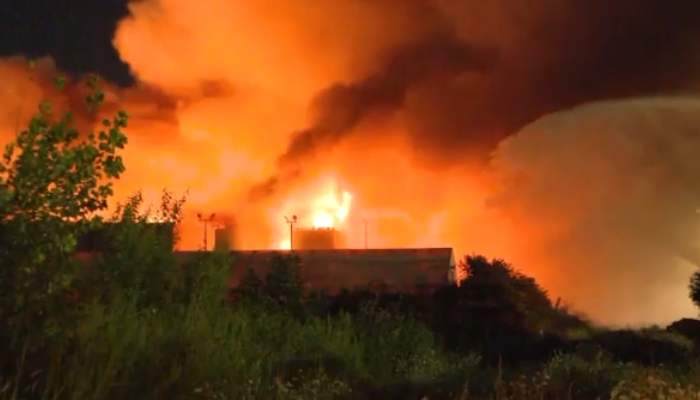
The Brenntag fire in Rexdale was one of the worst for the pollution of west-end waterways.
Community residents are concerned about the environmental damages caused by a massive six-alarm fire at Brenntag Canada Inc., more than three months ago.
The company claimed that about 700,000 litres of soybean and petroleum-based oil, transmission fluids and solvents were stored at the Vulcan Street facility at the time of the fire.
The Ministry of the Environment, Conservation and Parks has completed a technical report on the August 11 incident called Brenntag Canada Inc. Fire Off-Site Environmental Monitoring Summary Report.

Workers cleaning oily substances from many of the ducks which survived the chemical ordeal.
The report by Dr. Rachael Fletcher, a Director of Central Region, Drinking Water and Environmental Compliance Division, states the blaze caused heavy emulsions/slurry of oils and fire suppression materials along with fire douse water to enter the municipal storm sewer system and discharge into Mimico Creek, Humber Creek and the Humber Bay Park area of Lake Ontario.
Ministry officials said they sampled the air, sediment and water between August 11 and 23 for impacts from the fire to the environment and human health. It also included stream bank soil sampling and vegetation survey results.
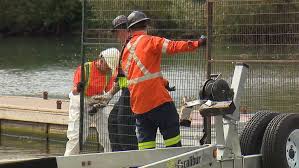
Workers cleaning up some our creeks and streams of the chemical spill from the fire.
“All measured air contaminant levels were far below their respective emergency screening values, confirming there were no local air quality concerns resulting from the fire,” according to a Ministry mobile trace atmospheric gas analyzer.
The report said officials ‘conducted extensive sampling of water, sediment, stream bank soil and vegetation to identify potential impacts of the run-off to Mimico Creek, Humber Creek and Lake Ontario.’
It said water and sediment samples were collected along Mimico Creek, Humber Creek, and Lake Ontario, and analyzed for petroleum hydrocarbons, volatile organic hydrocarbons, polyfluorinated alkyl substances, polycyclic aromatic hydrocarbons and metals.
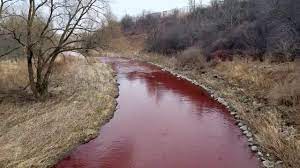
The Etobicoke Creek was previously polluted by an industrial ink spill.
“The main sources of contaminants were petroleum hydrocarbons and fire suppression materials,” according to the Ministry. “The results showed a decline in the concentration of contaminants over time and with increasing distance from the discharge points in the impacted waterways.”
They said the affected waterways are ‘returning to pre-spill/urban background conditions, with low levels of residual contamination remaining in the impacted waterways following the incident.’
“Sediment sampling results suggest that the current concentrations of contaminants would not have a significant impact on the resident organisms,” according to the report.

This poor fella looks hard done by covered in chemicals that spilled from the Brenntag fire.
Stream bank soil and vegetation samples showed elevated concentrations of contaminant compared to samples collected in non-impacted areas, the findings stated.
“These results suggest that the elevated concentrations in the creek bank vegetation adjacent to and downstream from Brenntag likely originated from the fire incident,” investigators determined.
Officials are now in the process of verifying the status of the cleanup before restoration work can begin; which is expected to be completed by November.

Effects from the fire are still felt today in South Etobicoke waterways, sediment and vegetation.
They said the cleanup’s effectiveness will be based on visual observations of the cleaned-up waterways, by monitoring results to applicable guidelines and background conditions, and assessment of whether additional cleanup is necessary or would cause greater harm to the environment.
“Should additional cleanup work be required, the ministry will ensure Brenntag will initiate the work immediately,” official said.
They said Brenntag has submitted a restoration plan that outlines how the water, soil, sediment, and vegetation will be assessed, restored, and monitored to demonstrate the effectiveness of cleanup efforts.
The Toronto District Office Duty Line can be contacted at 416-326-3381 during regular business hours or email environment.toronto@ontario.ca.
The report can be accessed at Brenntag-Canada-Inc.-Fire-Off-Site-Environmental-Monitoring-Summary-Report.pdf