
FORMER federal government IT worker Vachon Desjardins lived the high life until police moved in. Police photo.
This former federal government IT worker lived the high life until Canadian and U.S. police came knocking.
A Quebec man has pleaded guilty in Brampton Court for his role in one of Canada’s largest bitcoin seizures in which $35 million U.S. was seized by police.
An international task force made up of the RCMP and FBI arrested and charged Sebastien Vachon Desjardins, of Gatineau, with four offences in relation to his activity as part of the Netwalker Ransomware Group.
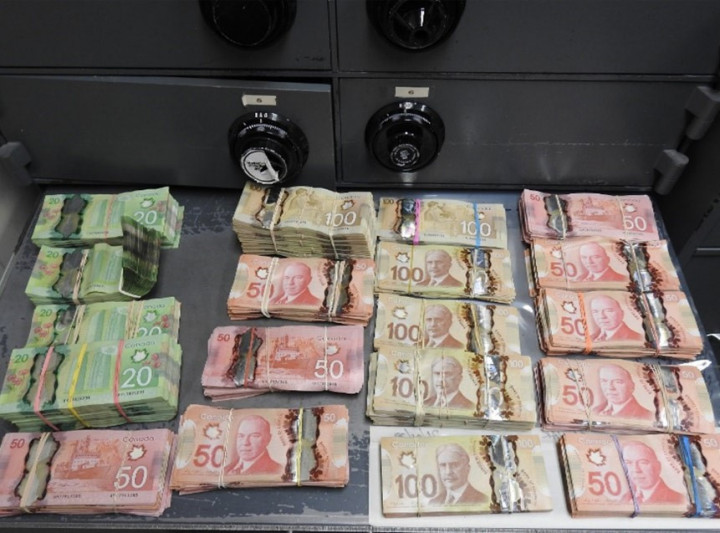
SOME $35 million U.S. in Bitcoin and almost one million Canadian were seized by police.
He was charged with mischief in relation to computer data, unauthorized use of a computer, extortion and participating in a criminal organization.
The RCMP and FBI searched his home in January 2021 and seized 719 Bitcoins, worth about $35 million and $790,000 in Canadian currency.
“The success of this particular investigation can be attributed to the dedication and hard work of the RCMP Cybercrime Investigative Team and the partner agencies involved,” said Supt. Kelly Bradshaw, Acting Director General, Federal Policing Criminal Operations.
Investigators seized more than 20 Terabytes of data from Desjardins’ computing and storage devices.
“The investigation identified 17 Canadian companies targeted by Desjardins,” according to police.

SCENE OF the crime, a corner office where police allege the scamming occurred.
The RCMP said the accused plead guilty to three of the four charges last January in Brampton court.
Justice G. Paul Renwick sentenced Desjardins to seven years in prison and ordered the forfeiture of 680 Bitcoins, most of the seized computing devices and $742,840 in Canadian funds.
Renwick also ordered the restitution of more than $2.6 million in Canadian funds to businesses that were affected by the criminal activity.
Desjardins was also ordered extradited to the U.S. to face charges there.
Media reports state that he previously worked as an IT consultant for Public Works and Government Services in Canada.
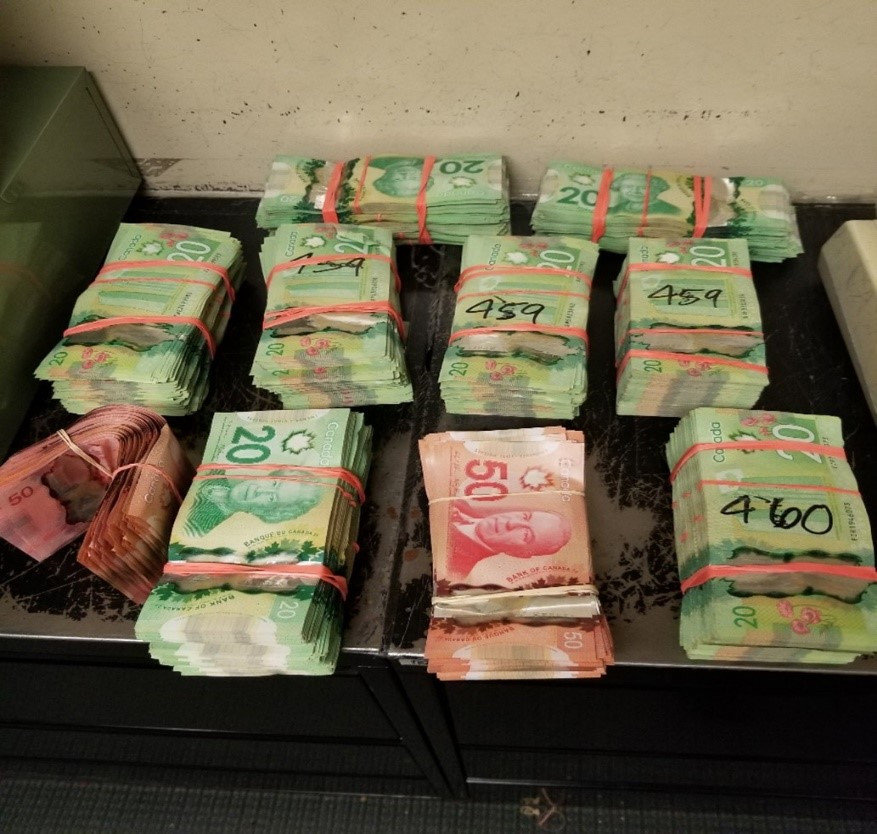
THERE WERE bundles of stolen cash in all denominations. Police photo.
U.S. police said NetWalker ransomware has impacted numerous victims, including companies, municipalities, hospitals, law enforcement, emergency services, school districts, colleges, and universities. Attacks have specifically targeted the healthcare sector during the COVID-19 pandemic, taking advantage of the global crisis to extort victims.
