
WELL-KNOWN Indigenous artist Philip Cote painting his latest work at Kipling Ave., and Lake Shore Blvd. W. He is known for his works across the city and beyond. Photo by
Tom Godfrey.

CAPTIVATING work by Philip Cote, known for his meticulous research. Courtesy photo.
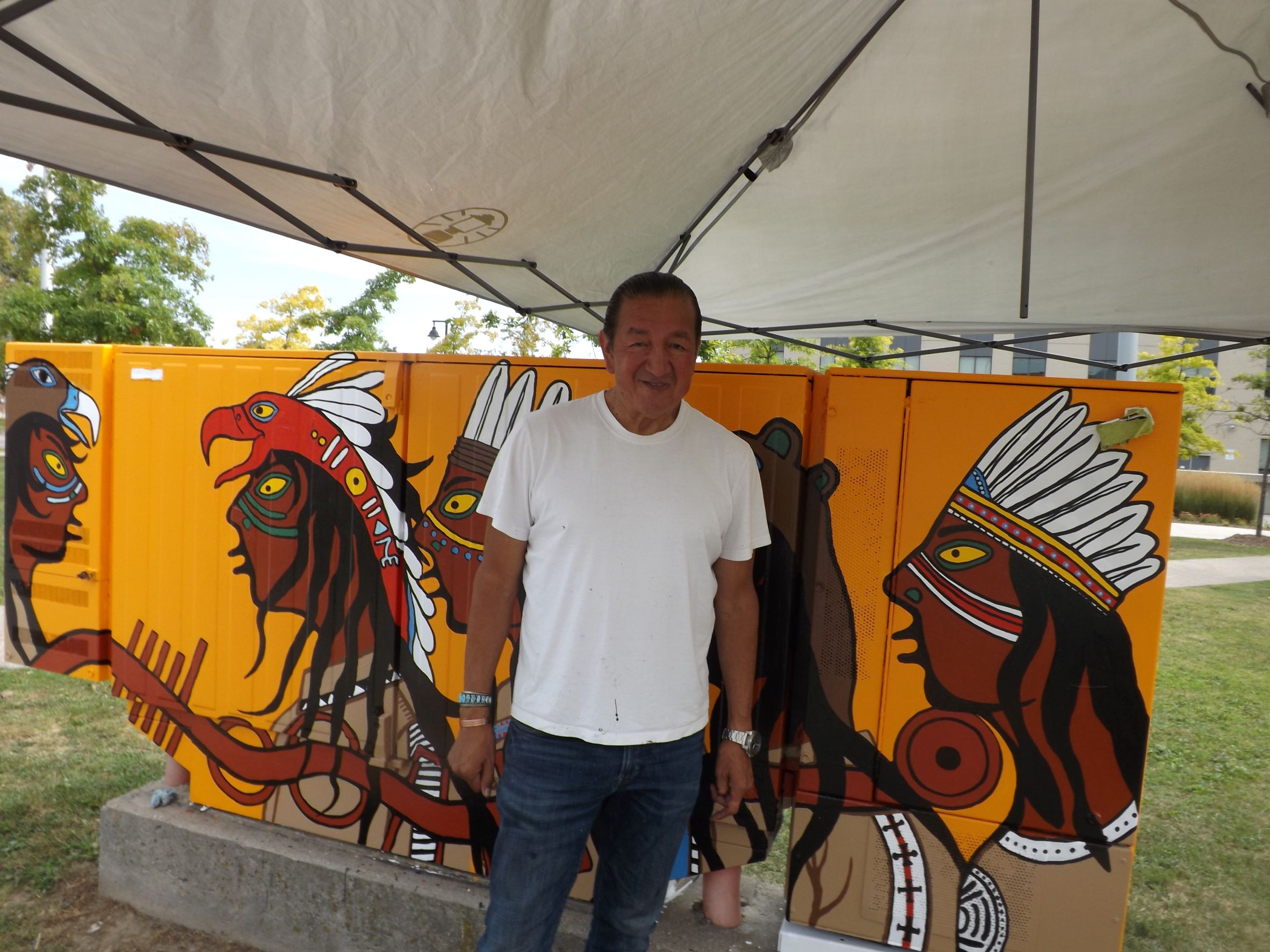
Many area residents have seen the bright, colourful native artwork of well-known New Toronto Indigenous artist Philip Cote in their travels in and around the city.
Cote, who has been living in South Etobicoke for more than 20-years, is an Anishinaabe-Algonquin painter, historian and young spiritual elder, whose works of art are sought after these days.
There has been a resurgence of interest in his work from outraged Canadians after the bodies of native children were found at some residential schools.
The native Sundancer, pipe carrier and sweat ceremony leader, has been working on a traffic signal box in the Kipling Ave. and Lake Shore Blvd. W. area for a week. He expects to finish the painting next week.
This painting tells the story of a gathering of Indigenous leaders in 1813 to discuss ways to block the attacking English at Lake Ontario. The art tells a story of a meeting that occurred about 200 years ago as native leaders planned to stop the advancing troops.
Cote pays meticulous attention to detail and research before getting down to work. His drawings are based on traditional storytelling, cosmology and oral history.
The artist, who hails from Moose Deer Point First Nation in Ontario, is said “draws upon his traditional storytelling and cosmology to communicate Indigenous history and knowledge independent of colonial narratives.”
He has painted more than 30 large and small images across the city and is proud of his work in taking the message to the next level for indigenous people. He did not have this sort of native art growing up and “wanted Indigenous community members to see reflections of themselves through his works across the city and to know they are home.”
As a graduate of Ontario College of Art & Design (OCAD) University’s art media and design master’s program, Cote explored Indigenous identity by studying the history of Indigenous leaders and peoples.
Cote has been involved in a number of murals in the Etobicoke area over the years. At Old Mill Road at Humber Park, he transformed the subway bridge into an outdoor gallery with 10 murals that depict different periods of Indigenous history.
In another traffic signal box entitled Etobicoke. “The art work tells the story of the land and it’s history with the Alder trees and the Algonquin peoples,” Cote explains. ”Etobicoke means the “place of the Alders” these trees were the first to bring shelter to the landscape after the Ice age to protect the soil from erosion and give shelter to the flora and fauna.”
Cote’s great-grandfather is the great- grandson of Tecumseh, and he is engaged in exploring the importance of the Shawnee leaders’ life and spirit. His work: Tecumseh, A Portrait, Dismantling the Myth, included a series of posters of Indigenous leaders and heroes spanning 350 years of resistance to colonialism.
Philip has won a number of Toronto Association of Business Improvement Area (TABIA) awards for his public Street Art Murals across the City of Toronto.