
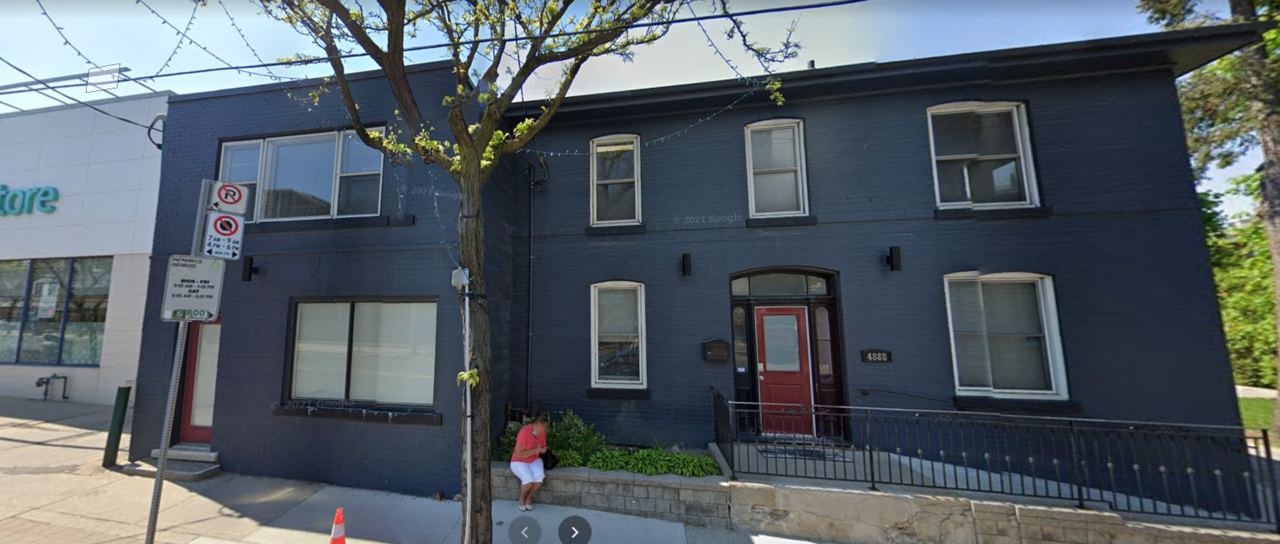
The Heritage Musson House that was built in 1887 is proposed to be part of 29-storey condo high-rise.
A proposal is being considered to build a 29-storey building around a 136-year-old Etobicoke heritage home that used to be Village of Islington Post Office and telephone exchange.
A virtual community consultative meeting will be held on November 23 to get feedback on the plan.
City officials said a revised Official Plan and Zoning by-law Amendments are being sought to allow the construction of a 29-storey mixed use building at 4884 Dundas St. W., with 395 units and 1,322 square metres of ground floor retail space.
“The heritage building at 4884 Dundas St. W., would be retained and relocated within the site,” according to a notice for residents advising them of the meeting.

The Musson House will look something like this if plans go ahead.
There will be loading area, two pickup-drop off spaces and a single-level underground parking with 77 parking spots with proposed access from Burnhamthorpe Road. Spaces for 169 bicycles are proposed.
The Musson House, as it is called, was designated a heritage building in 2006. It was constructed in 1887 and was the Village of Islington Post Office until 1906 and then residence of postmasters Thomas and Elizabeth Musson.
From 1912 to 1925 the property served as the local telephone exchange operated by Olive Newlove, who owned the property with husband, William.
The property was later sold to dentist Dr. and Mrs. Nicholas Brown and a small modern-style addition was added to the front corner of the house.

An artist rendering of the complex but the building will be 29 floors. A public consultative meeting takes place on November 23 for the project.
By 1879, when the Musson House was constructed for a Township clerk, the Village of Islington contained 200 people and had just gained railway service the same year.
“The property has historical value given that it yields information that contributes to an understanding of the historical development of the Village of Islington,” city officials said.
The units include a mix of 12 studios, 100 one-bedrooms, 90 two-bedrooms and 23 three-bedrooms.
Rockport Group developers has submitted a rezoning and site plan application to develop the site at 4884-4896 Dundas Street West with a new 29-storey mixed-use building while retaining a portion of the existing heritage building at the east end of the site.
A Heritage Impact Statement propose that the east and south façades be preserved, its red brick restored.
The proposal states that Islington subway station on Bloor Line 2 is a 750-metre away and is a 9 to 11-minute walk, while Burnhamthorpe 50 buses stop just to the west of the site and run right to the station.

That section of Dundas St. W., by Burnhamthorpe Rd., will look similar to this if some of the building projects get the green light.
One stop away, and accessible via the Lambton 50 buses that ply Dundas, Kipling station also offers GO trains, the Airport Rocket bus, and MiWay buses to Mississauga.
The city said Dundas Street West was a strategic and military route constructed by Governor Simcoe in 1795 connecting Toronto with Burlington Bay at the West end of Lake Ontario.
Originally the route was to the south following the shoreline topography of the ancient, glacial Lake Iroquois, but in 1814 the road was shifted northward to higher land to more closely follow its current route through what would become the village of Islington.
Within two years public stagecoaches were operating along the route where the Village of Islington would come to be located.
Two other sites in the area were designated under Heritage Act, and includes the Montgomery Inn, built in 1832, and the Etobicoke Township Hall, that was built 1843 as a Methodist church.
Also deemed as heritage is the Islington United Church, built in 1949, and 66 Burnhamthorpe Road, which was the Johnston residence built in 1907 for descendants of the first settlers to the area.